
• Search a tuning box :
  • Search
  • Combining performance and fuel efficiency

    Saving fuel while having a better reserve of power and torque, that's what a tuning box allows. We tested the product on a compact 2.1 l van with 95 hp. The results are impressive.

    See a copy of the original article (FR)
    English translation - original article published in French by L'Utilitaire léger


    There are now products on the market that can increase your vehicle's power and torque while reducing fuel consumption. Some require professional intervention but others can be installed without any technical knowledge. This is the case with tuning boxes.
    "Our customers are invited to install their chip themselves, which is possible thanks to the original connectors that are systematically supplied with our products," explains Philippe Heeren, Belgian manufacturer of P-Tronic tuning boxes. The phenomenon is gaining momentum here where nearly 7,000 vehicles are equipped this way each year: cars, motorhomes and light commercial vehicles where the performance chip is often chosen to compensate for the heavy load that must be carried on board by the professionals who use them.

    Wider ranges

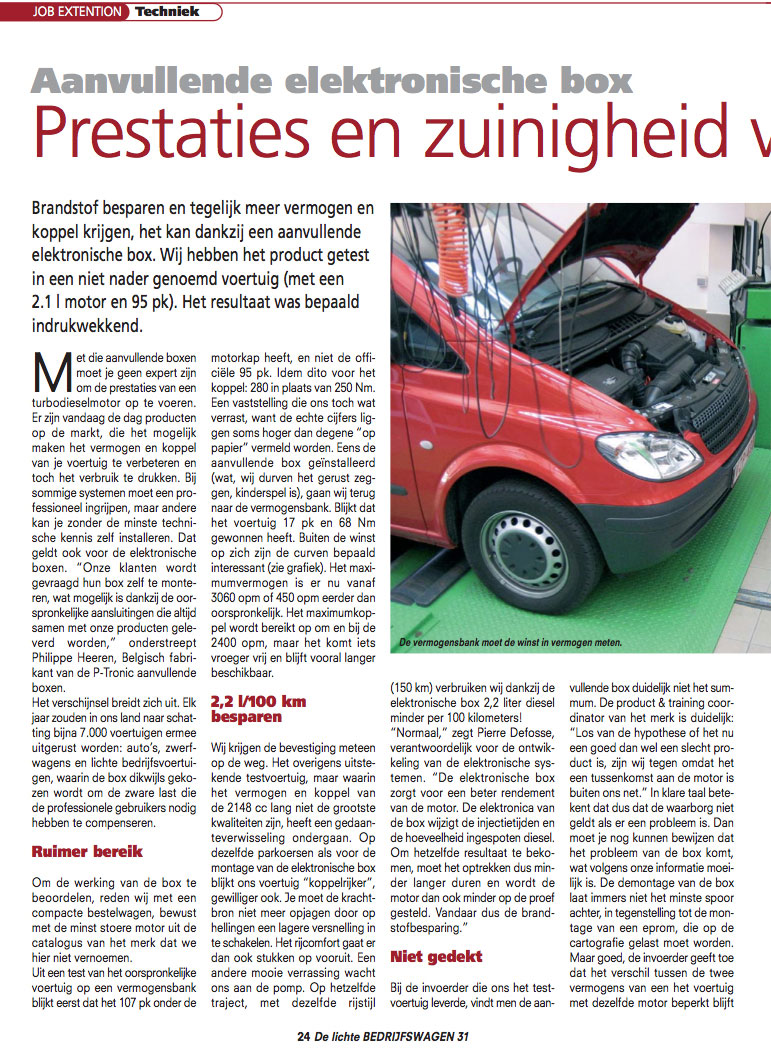
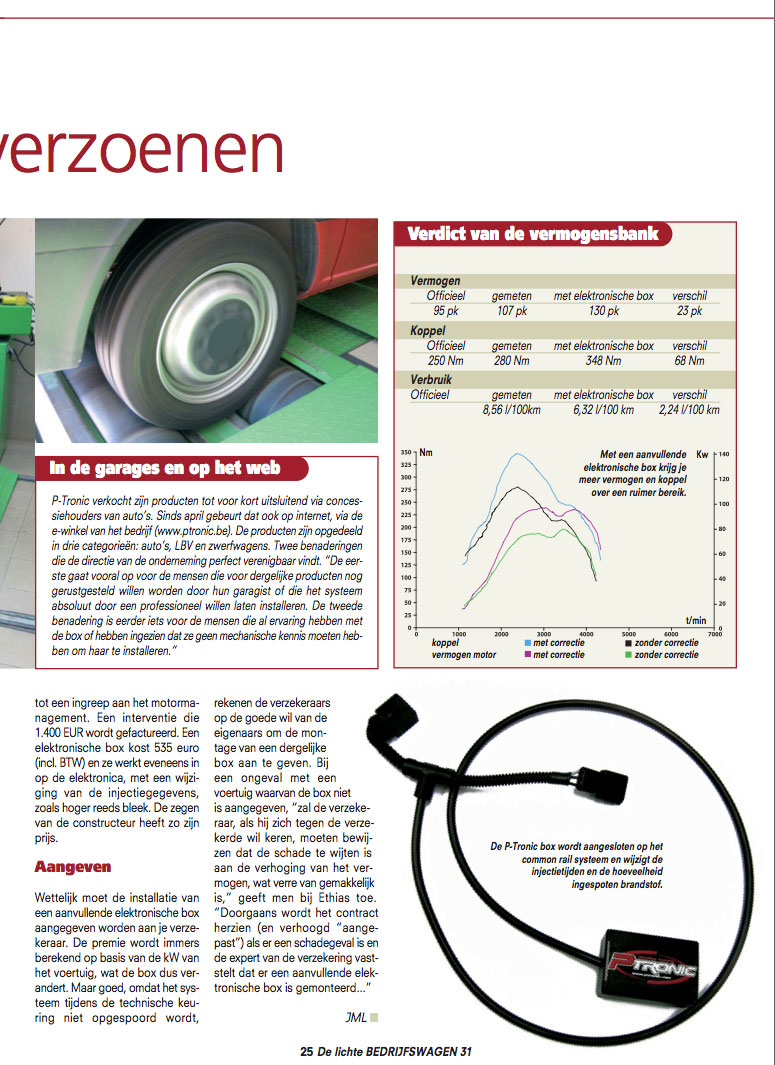
    To verify the effect of the tuning box, we used a van. Deliberately, the least powerful engine in the brand's catalog, which we won't name. A dyno test of the stock vehicle first reveals that our vehicle houses 107 hp under the hood and not 95 hp as announced by the manufacturer. Same for maximum torque: 280 Nm instead of 250 Nm.
    A finding that doesn't surprise us much, as actual values are sometimes higher than those indicated "on paper." Once the tuning box is installed (which is, we can confirm, child's play), a new dyno test reveals that the vehicle has just gained 17 hp and 68 Nm. Beyond the pure gain, it's the shift in the curves that is interesting (see graph). Maximum power is delivered from 3060 rpm, 450 rpm earlier than stock. As for maximum torque, while it's still reached around 2400 rpm, it also starts to be released slightly earlier and, above all, it remains available longer.

    2.2 l/100 savings

    Confirmation on the road where our test utility vehicle, an excellent vehicle nonetheless but whose power and torque from the 2.148 cc are far from being its primary qualities, is transformed. Taking the same routes as before installing the chip, the vehicle shows more "torque," more willingness. No more need to rev up the engine by engaging a lower gear on hills. Driving comfort is inevitably enhanced. Another major surprise awaits us at the pump. Covering an identical route with equal driving (150 km), the tuning box allowed us to consume 2.2 liters less diesel per hundred kilometers!
    "Normal," explains Pierre Defosse, head of electronic equipment development, "the chip allows the engine to have better efficiency. The box's electronics modify injection durations as well as the quantities of diesel injected. The adaptation means that to achieve the same result, acceleration must be shorter, the mechanics must be less stressed. Hence, the fuel savings."

    Not covered

    At the importer who provided us with the vehicle, let's be clear, the tuning box is problematic. The brand's Product & Training Coordinator: "Regardless of whether it's a good or bad product, we're against it in the sense that it's an intervention performed on the engine outside our network." In other words, in case of a problem, the warranty is void. Still, one must be able to prove that it was generated by the chip, which, according to our information, is all the more difficult since removing the tuning box leaves no trace, unlike installing an EPROM which must be soldered onto the mapping. That said, the importer acknowledges that the difference between two power levels on the vehicle for the same engine block is limited to an intervention at the "motor management" level. An intervention that costs 1400 EUR while a performance chip costs 535 EUR including VAT and its action is also at the electronic level, modifying injection parameters as we've seen. The manufacturer's blessing comes at this price.

    Must be declared

    Legally speaking, note that installing a tuning box must be declared to your insurer. Indeed, the premium is calculated based on the vehicle's kW, a value that the chip modifies. That said, as the equipment is not detected during technical inspection, insurers rely on drivers' good faith to declare its presence in the engine. And in case of an accident with a vehicle whose chip has not been declared "the insurer, if they want to turn against the insured, will have to prove that the claim is due to the power increase, which is far from obvious," is acknowledged at Ethias. "As a general rule, when a claim occurs and the insurance expert notes the presence of a tuning box, the contract is simply revised upward..."


    In garages and on the web

    P-Tronic sold its products until recently exclusively through car dealerships. Since April 2007, the company has also been marketing them on the internet via its e-shop (www.ptronic.be) dividing its products into three categories: cars, LCVs and motorhomes. Two approaches that the company's management considers perfectly compatible. "The first mainly concerns people who still need to be reassured by their mechanic about this type of product or who want to have it installed by a professional at all costs. The second affects more people who have already had experience with the chip or who have understood that mechanical knowledge is not needed to install it."

    © P-Tronic - Speed-up SRL - Avenue des Tilleuls 8/1C - 4802 Verviers - Belgium - VAT : BE 0477.924.839

    This website uses cookies which you can configure.