
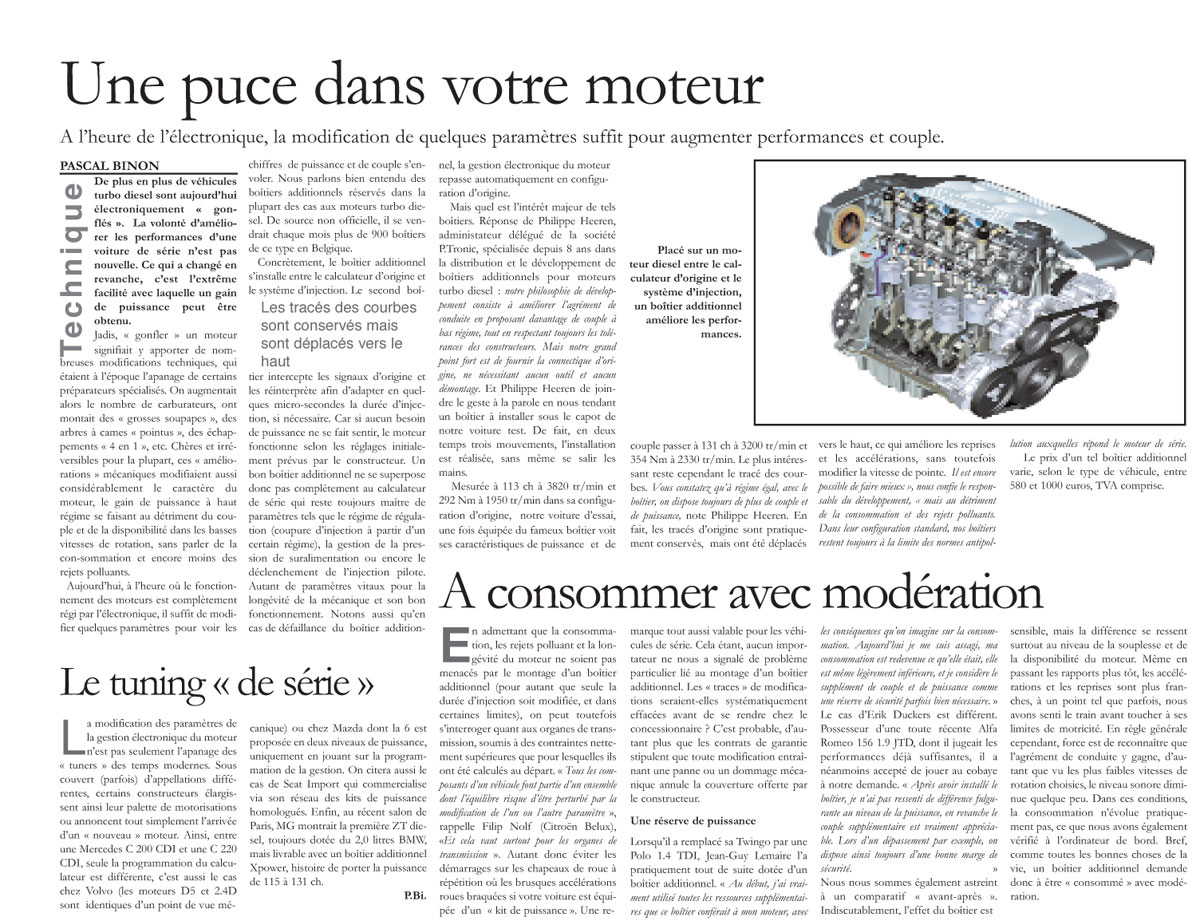
More and more turbo diesel vehicles are now electronically "boosted". The desire to improve the performance of a production car is not new. What has changed, however, is the extreme ease with which a power gain can be obtained.
Pascal Binon
In the past, "boosting" an engine meant making numerous technical modifications, which were at the time the preserve of certain specialized tuners. They would increase the number of carburetors, install "big valves," "aggressive" camshafts, "4-into-1" exhausts, etc. Expensive and mostly irreversible, these mechanical "improvements" also considerably modified the engine's character, with high-RPM power gains coming at the expense of torque and availability at low rotation speeds, not to mention consumption and even less pollution emissions.
Today, in an era where engine operation is completely governed by electronics, it's enough to modify a few parameters to see power and torque figures soar. We're talking of course about tuning boxes reserved in most cases for turbo diesel engines. From unofficial sources, more than 900 box-units of this type are sold each month in Belgium.
Concretely, the performance chip is installed between the original ECU and the injection system. The second unit intercepts the original signals and reinterprets them to adapt the injection duration in a few microseconds, if necessary. Because if no power need is felt, the engine operates according to the settings initially planned by the manufacturer. A good tuning box therefore doesn't completely override the stock ECU which always remains in control of parameters such as regulation speed (injection cutoff from a certain RPM), boost pressure management or pilot injection triggering. All vital parameters for mechanical longevity and proper operation. Note also that in case of box-unit failure, the engine's electronic management automatically returns to original configuration.
But what is the major benefit of such chips? Response from Philippe Heeren, managing director of P-Tronic, a company specialized for 8 years in the distribution and development of tuning boxes for turbo diesel engines:
"Our development philosophy consists of improving driving pleasure by offering more torque at low RPM, while always respecting manufacturers' tolerances. But our great strength is providing original connectors, requiring no tools and no disassembly."
And Philippe Heeren follows words with action by handing us a performance chip to install under the hood of our test car. Indeed, in no time at all, the installation is done, without even getting our hands dirty.
Measured at 113 hp at 3820 rpm and 292 Nm at 1950 rpm in its original configuration, our test car, once equipped with the famous tuning box, sees its power and torque characteristics rise to 131 hp at 3200 rpm and 354 Nm at 2330 rpm. The most interesting part, however, remains the curve plots.
"You'll notice that at equal RPM, with the chip, you always have more torque and power," notes Philippe Heeren. "In fact, the original plots are practically preserved, but have been shifted upward, which improves acceleration and pick-up, without however modifying top speed. It's still possible to do better," the development manager confides, "but at the expense of consumption and pollution emissions. In their standard configuration, our box-units always remain within the limits of the pollution standards that the stock engine meets."
The price of such a tuning box varies, depending on the vehicle type, between 580 and 1000 euros, VAT included.
Assuming that consumption, pollution emissions and engine longevity are not threatened by installing a performance chip (provided only injection duration is modified, and within certain limits), one can however wonder about transmission components, subjected to significantly higher stresses than those for which they were initially designed.
"All components of a vehicle are part of a whole whose balance risks being disturbed by modifying one parameter or another," reminds Filip Nolf (Citroën Belux), "And this especially applies to transmission components."
Therefore avoid repeated wheel-spinning starts or sudden accelerations with wheels turned if your car is equipped with a "power kit." A remark equally valid for production vehicles. That said, no importer has reported any particular problem related to installing a tuning box. Are "traces" of modifications systematically erased before going to the dealer? It's likely, especially since warranty contracts stipulate that any modification causing a breakdown or mechanical damage voids the manufacturer's coverage.
When he replaced his Twingo with a Polo 1.4 TDI, Jean-Michel Lodez practically immediately equipped it with a box-unit.
"At first, I really used all the additional resources that the chip gave my engine, with the consequences you can imagine on consumption. Today I've calmed down, my consumption has returned to what it was, it's even slightly lower, and I consider the extra torque and power as a safety reserve that's sometimes quite necessary."
Erik Duckers' case is different. Owner of a very recent Alfa Romeo 156 1.9 JTD, whose performance he already judged sufficient, he nevertheless agreed to play guinea pig at our request.
"After installing the tuning box, I didn't feel a dramatic difference in power, on the other hand the additional torque is really appreciable. When overtaking for example, you thus always have a good safety margin."
We also subjected ourselves to a "before-after" comparison. Undoubtedly, the box-unit's effect is noticeable, but the difference is felt especially in the engine's smoothness and availability. Even when shifting gears earlier, accelerations and pick-ups are sharper, to such a point that sometimes we felt the front axle touching its traction limits. Generally speaking however, it must be recognized that driving pleasure gains from it, especially since given the lower chosen rotation speeds, the noise level decreases somewhat. Under these conditions, consumption hardly changes, which we also verified on the trip computer. In short, like all good things in life, a performance chip therefore needs to be "consumed" in moderation.
Modifying engine electronic management parameters isn't only the preserve of modern "tuners." Under cover (sometimes) of different names, some manufacturers thus expand their range of engines or simply announce the arrival of a "new" engine. Thus, between a Mercedes C 200 CDI and a C 220 CDI, only the ECU programming is different, this is also the case at Volvo (the D5 and 2.4D engines are mechanically identical) or at Mazda whose 6 is offered in two power levels, only by adjusting management programming. We'll also mention Seat Import's case, which markets approved power kits through its network. Finally, at the recent Paris Motor Show, MG showed the first ZT diesel, still equipped with the 2.0 liter BMW, but deliverable with an Xpower tuning box, to raise power from 115 to 131 hp.
P.Bi.
This website uses cookies which you can configure.